





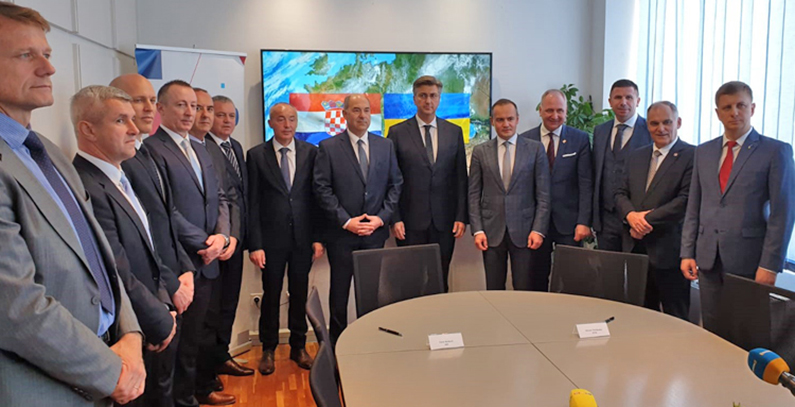
Slika. Signing ceremony (HEP)


Croatian power utility Hrvatska Elektroprivreda (HEP) and Ukrainian energy holding company DTEK have signed a memorandum of understanding and business cooperation.
The memorandum was signed by DTEK’s Chief Executive Officer, Maxim Timchenko, and the President of HEP’s Management Board, Frane Barbarić, in the presence of the Prime Minister of the Croatian government, Andrej Plenković, and the Croatian government ministers.
According to DTEK’s press release, the first step in the framework of cooperation is a test electricity supply by DTEK Hungary Power Trade to HEP in the amount of 2.5 GWh, in October this year. Next year, trade can reach up to 1,300 GWh, DTEK said.
The first step in the framework of cooperation is a test electricity supply by DTEK Hungary Power Trade to HEP
The memorandum of understanding and business cooperation presents the foundation of future cooperation between the two companies, through their cooperation in third markets and joint investments in the field of generation and trade of electricity, gas and other energy products, HEP said on its website.
The company said that the importance and potential of the memorandum is reflected in the fact that DTEK is the biggest private energy company in Ukraine, the country’s biggest private producer of gas, and one of its three biggest investors in renewable energy sources (solar and wind). DTEK’s total installed capacities for electricity generation amount to 17 GW, while it distributes electricity for 3.6 million customers.
“The MoU is another step towards expanding DTEK’s presence in the European energy markets”
“The memorandum is another step towards expanding DTEK’s presence in the European energy markets. It will make the Ukrainian energy system closer to the European energy system, contributing to further strengthening of the energy security of Ukraine,” DTEK CEO Maxim Timchenko said.
“Big opportunities for intensive mutual cooperation in the development of renewable sources”
Frane Barbarić, President of HEP’s Management Board, said that regarding renewable energy sources, both HEP and DTEK have achieved a significant breakthrough in recent years.
“We see big opportunities for intensive mutual cooperation in the development of renewable sources,” Frane Barbarić, President of HEP’s Management Board, said.
A few days ago, HEP started building the Korlat wind farm near Benkovac – the company’s first wind farm.
Be the first one to comment on this article.