





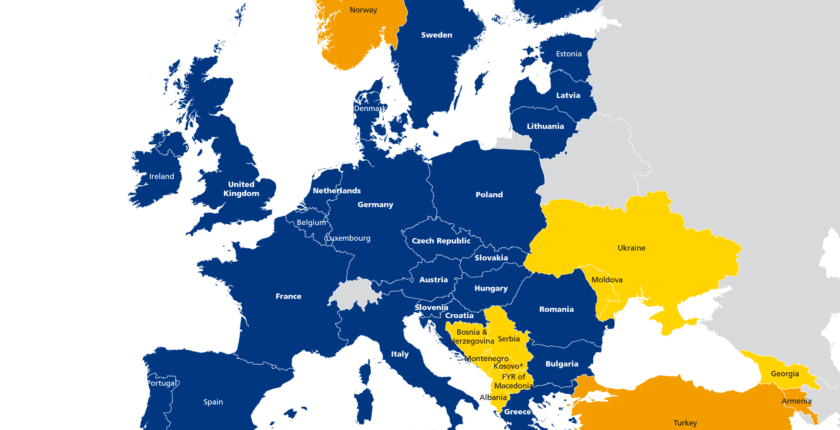
Photo: Energy Community


Reforming the current weak sanction regime under the Energy Community Treaty is seen as an instrument to improve the track record of the Contracting Parties in implementing the Energy Community acquis.
The Energy Community Secretariat said this in its latest report Knocking on the EU’s Door through the Energy Community: Integration of Western Balkans into the Pan-European Energy Market.
According to the Energy Community’s statement, at a time when EU accession of the Western Balkans (WB) returns to the agenda, this report provides a snapshot of the progress made by the countries of the WB towards integration with the EU in the areas covered by the Energy Community Treaty.
“Another instrument to improve the track record of the Contracting Parties in implementing the Energy Community acquis is strengthening the existing enforcement mechanism. While changing the political governance culture of a country is a long-term process, reforming the current weak sanction regime under the Energy Community Treaty, which has proved insufficient when dealing with matters where energy reforms collide with political interests, is a relatively low hanging fruit,” the report underlines.
According to the document, the experience of the Energy Community in terms of relatively high transposition records as compared to implementation should serve as a message to the EU that further attention needs to be given to creating an appropriate governance and supporting the implementation capacities in the WB countries.
“Most importantly, it is vital that the region does not get left behind in the clean energy transition currently underway in the EU (most notably the Clean Energy Package of 2016). Missing this bandwagon could have expensive, long-term repercussions on the WB. What is more, the region’s citizens should not have to wait for better-quality energy services and improved health and living conditions,” the Energy Community Secretariat said in its report.
As outlined in the document, Montenegro is the frontrunner in terms of compliance with obligations under the Energy Community Treaty. Serbia is performing well on the books but is slow in the real implementation of the acquis in wording and spirit. The two countries have started EU accession talks.
They are followed by Albania and former Yugoslav Republic of Macedonia, both having obtained EU candidate country status and currently at a crossroads between accelerating and stagnating with energy sector reforms. Kosovo* has a good track record in transposition under difficult external circumstances but must do more to get its market structure and environmental performance right. Finally, Bosnia and Herzegovina, as an aspiring potential candidate for EU membership, lags behind the others.
China, Russia – unthinkable, unacceptable
The report also looks at the influence of the China, Russia, and Turkey.
“While the aspiration of the Western Balkan countries to join the EU is undoubted, the Energy Community also sees evidence that other players with different interests, notably China, Russia, and Turkey, have strong interests in the region, especially when it comes to energy,” the report said.
While a comprehensive assessment of these impacts goes beyond the scope of this report, as said in the document, it is added that these countries are profoundly affecting the energy landscape of the WB.
“In the last decade, China has supported investments in new energy generation capacities, including coal-fired power plants that are unthinkable in the vast majority of EU countries today. Turkey’s investment in the region’s energy sector is expanding. Russia continues to dominate the gas market in such a way that would be unacceptable in the EU. The integration of the Western Balkan countries into the EU’s internal energy market via the Energy Community, even with its flaws, remains the most effective tool to counteract these influences,” the report notes.
The main challenges
The gap between transposition of EU rules and implementation in practice, as noted in the report, is partially linked to systemic failures, including weakness of enforcement, corruption, lack of rule of law, political governance, etc.
“A key challenge remains the strengthening of national authorities – energy regulators, energy agencies, competition and State aid authorities, which lack the strength and independence to act as effective and pro-active guardians of the transposed acquis. Public administration capacities also remain low, especially in sectors like energy efficiency and climate, which are still unfortunately considered second-class priorities in the Balkans,” the report noted.
A number of regional conflicts continue to hamper progress in the energy sector, in particular, the ongoing dispute between Serbia and Kosovo*.

Be the first one to comment on this article.