


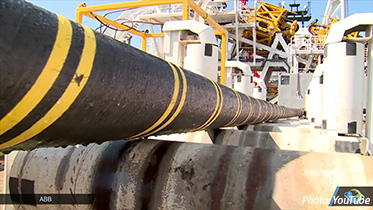
The Ministry of Sustainable Development and Tourism issued a building permit to company Terna Crna Gora d.o.o. for the installation of an undersea power cable through Montenegrin territory.
The building permit is issued for setting up the 500 kV high voltage, direct current (HVDC) submarine and underground cable for electricity transmission in the section through Montenegro within the detailed spatial plan (DPP), a 400 kV highline with optical cable from the coast to Pljevlja in the country’s north, and the undersea cable of 500 kV with optical cable from Italy to Montenegro, the decision says.
The investor loses building rights if it does not start to build the facility within two years, the document says.
The route starts at the entry into territorial waters of Montenegro and ends with a connection to the converter station in Lastva. The exit to mainland will be on the northern area of cape Ponta near Jaz beach, the resolution says. The submarine cables will cross the coast through the previously deposited HDPE pipes. The entry point into the sea is at ten meters depth, and access to the land is within the connecting sea-land chamber where the submarine cables will be connected to the ground cables.
Trenches go along the side of the hill toward the main road Budva-Kotor. After passing under the primary road, the line is connected to substation Blato in Lastva Grbaljska. The investor loses building rights if it does not start to build the facility within two years, the document says. Terna applied for the permit from the ministry on June 22.
The project of connecting Italy and Montenegro with a submarine line is worth almost EUR 1 billion. Italian company Terna SpA is providing 80% of funding, while Montenegrin Electric Power Transmission System (CGES), government-controlled power transmission system operator, contributes EUR 100 million, enough to construct the substation in Lastva and the landline towards Pljevlja. On January 25, 2011, Terna and CGES signed a contract about project coordination, which foresees that the government has an obligation to provide the rights to use state land, including the sea, necessary for implementing the part of the project in Montenegro.