







Photo: SERDA


Share


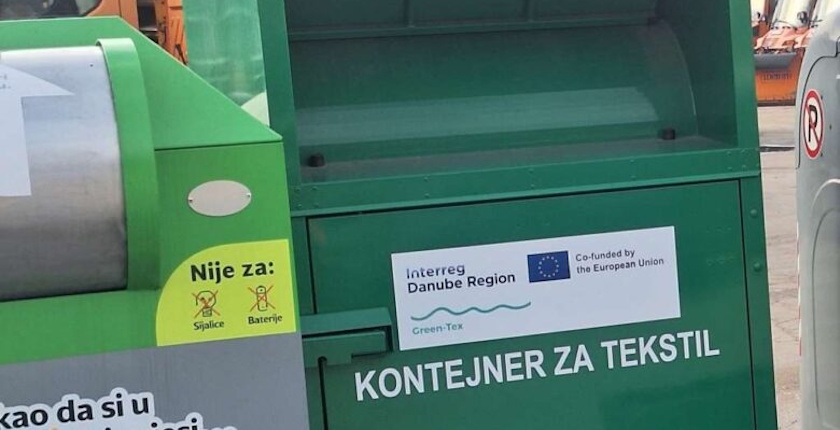
Sarajevo, the capital of Bosnia and Herzegovina, has introduced ten special containers for the separation and recycling of textile waste.
The containers were installed as part of the Green-Tex project, which is part of the Danube Region Programme under the European Union’s Interreg initiative. The project is estimated at EUR 1.8 million, and 80% is funded by Interreg.
The Green-Tex consortium is made up of 11 organizations from nine countries: Slovakia, Slovenia, Croatia, Hungary, Bulgaria, Bosnia and Herzegovina, Montenegro, Serbia, and Romania.
The project, led by the Sarajevo Economic Region Development Agency (SERDA), began in 2024 and is ending this year.
The agency pointed out that more than 80% of textile waste in BiH ends up in landfills, where it decomposes for decades and pollutes the environment.
All collected material will be recycled, repurposed, or taken for reuse
SERDA stressed that it launched a pilot initiative in Sarajevo in cooperation with the Ministry of Communal Economy, Infrastructure, Spatial Planning, Construction and Environmental Protection of the Sarajevo Canton, under the Gren-Tex project. The aim was to reduce textile waste and protect the environment, it added.
With the support of public waste utility KJKP RAD, containers for textile waste have been placed at several locations in Sarajevo canton, mostly at the firm’s recycling yards.
Used and end-of-life textiles – clothing, bedding, and other fabrics – can be dropped off there. All collected materials will be recycled, repurposed, or reused, thereby helping the environment and those in need, according to SERDA.
The containers are equipped with smart monitoring solutions, for optimizing collection, the FENA state news agency reported.
The results will determine whether these technological solutions can be adapted to other waste types
Sensors have been installed in 10 containers to measure the fill levels and report data, based on which dispatchers send trucks. According to SERDA project manager Amela Ikić Suljagić, this model saves fuel, resources, and time.
The pilot initiative, which ends in April, will quantify textile waste collection and help shape future strategic planning, she explained.
The results will also determine whether these technological solutions can be adapted to other waste streams, in her view.
Green-Tex will create and test new solutions throughout the value chain – from fashion design to production and usage to textile waste collection – and verify them in various contexts within the project area.
Digital solutions will be an integral part of the Green-Tex project, because all partner regions need an effective textile waste collection system with publicly available online maps of collection points, supported by awareness-raising campaigns, according to the project’s website.




Be the first one to comment on this article.