


News

Mecasolar supplies horizontal trackers to solar plant

Published

July 1, 2015

Comments

comments icon

0

Share

Published:

July 1, 2015

Comments:

comments icon

0

Share

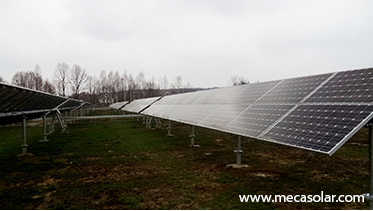
A total of 47 trackers, using 420 axes of up to 10.8 kW per axis, and 18,960 modules of 240 W nominal power will be installed by Mecasolar (Mecanizados Solares SL) in a new solar power project in Korkuteli in Antalya province.

The company said the delivery of equipment of 4.5 MW to the facility situated 390 kilometers southwest of Ankara strengthens its presence in the Balkans, where it plans to develop 30 MW by 2017. According to Mecasolar, headquartered in Fustiñana, Spain, its 140 kW horizontal single-axis tracker is a modular, low-height structure characterized by simple assembly, no welding on location and higher output.

In May, the company said it equipped a new solar project in Miroslava, 400 kilometres north of Bucharest, Romania, with 97 dual axis trackers of 10.31 kW and more than 4,170 photovoltaic modules.
Related Articles

world bank prosumers solar financing republic of srpska

World Bank could finance 20,000 prosumers in Republic of Srpska

23 February 2026 - The World Bank intends to provide a loan for a prosumer project in the Republic of Srpska, with a financing decision expected as early as May

world ppa bloombergnef report 2025

Global clean PPA market shrinks for first time in nearly one decade

23 February 2026 - Tech giants contracted almost half of the total volume, and firm power deals are set to become dominant, according to a BloombergNEF report

Saudi Acwa USD 5 billion renewables investment Turkey

Saudi’s Acwa starts USD 5 billion renewables investment in Turkey

23 February 2026 - Saudi Arabian energy utility Acwa agreed to build two photovoltaic plants in Turkey, of 1 GW each. It is the first phase of a 5 GW plan.

europe zero emission urban buses transport environment

Electric vehicles clearly dominate European city bus market

23 February 2026 - Last year 60% of new city buses in the EU were powered by electricity, and hydrogen, according to Transport & Environment