





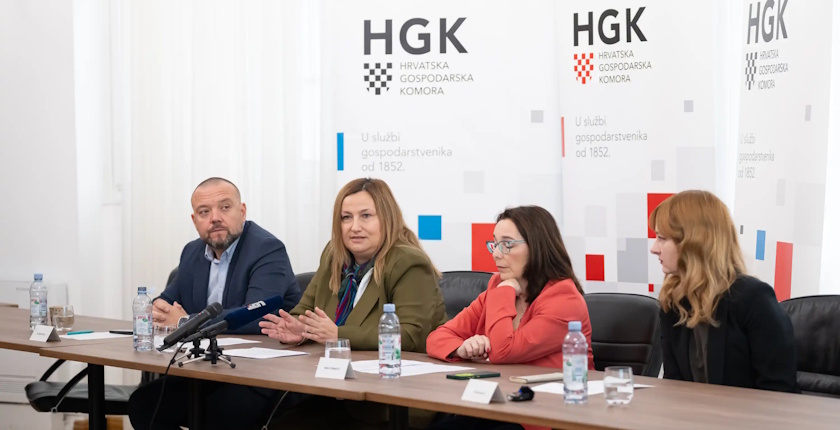
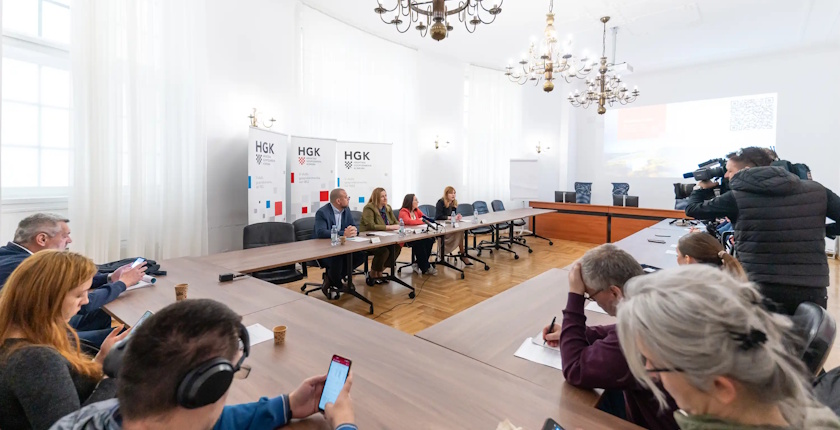
Photo: HGK


Croatia currently has 11 MW of battery energy storage systems, and by the end of the year, it could increase it to 150 MW, according to the Croatian Chamber of Economy. The key problem is that business models for battery operators are limited.
The technology for battery energy storage systems ranks first in terms of investor interest, the Croatian Chamber of (HGK) stressed.
It published a position paper on barriers to battery investments in Croatia. This is its third document dealing with the renewable energy sector in the country.
In HGK’s view, Croatia lacks a solution for when electricity production from renewables is high and consumption is low. Three years ago, due to congestion in the transmission network, an amount of green energy enough to supply more than 20,000 households for 12 months was curtailed.
Croatia imports 60% of the energy it consumes
Croatia imports 60% of the energy it consumes, and fossil fuel imports are the primary factor of its trade deficit, HGK recalled.
Tamara Kelava, Head of the Energy, Environment and Utilities Division at HGK, noted that investors are waiting for the grid connection fee to be determined – since September 2022, or a total of 1,200 days.
The connection fee is the key factor to decide if a project is profitable, she added.
Domazet: Batteries can help provide cheaper ancillary services
Nina Domazet, Independent Advisor at the Energy, Environment and Utilities Division and secretary of the Association for Renewable Energy Sources of HGK, pointed out that batteries are not a magic wand for the Croatian power system.
However, they can help, in the short term, to mitigate system problems and provide cheaper ancillary services to the transmission system operator (TSO), thereby indirectly affecting electricity costs, in her view.
“The National Energy and Climate Plan (NECP) envisages the construction of 250 MW of batteries by 2030, and we expect to reach only about 60% this year. In comparison, the EU recorded an increase in new battery systems of about 45% last year alone. Within those new capacities, the majority refers to large systems and not, for example, household storage,” Domazet explained.
In addition to the connection fee, the calculation of grid charges is currently not precisely defined for batteries, and adjustments are needed in defining the curtailment fee, HGK added.
The key problem is that business models are limited
HGK underscored that the key problem with investments in BESS in Croatia is that business models are limited.
Aljoša Pleić, Deputy President of the Association for Renewable Energy Sources, explained that the role of batteries shouldn’t be determined by spatial regulations at all, but only by energy regulations.
The framework restricts the arbitrage business model for batteries, he added.
Pleić: The current model doesn’t allow batteries to reach their full potential
In his view, it doesn’t allow batteries to reach their full potential in terms of providing ancillary services to the operator.
“In an arbitrage battery operation, the battery system is charging when the electricity price is low, and discharging when the price is high. This is one of the basic market models of battery storage operation in a liberalized electricity market, which also has a favorable effect on the final price of electricity,” Pleić pointed out.
For investors in Croatia, there is also the question of whether the energy approval for an existing power plant needs to be changed if batteries are added and if installing a BESS will affect the status of a privileged electricity producer, according to HGK.


Be the first one to comment on this article.