


The price of grid connection in Croatia will be unveiled in July at the latest, which could unlock EUR 1 billion worth of investments in renewable energy sources, said Ivo Milatić, State Secretary in the Ministry of Economy and Sustainable Development.
The fee for connecting power plants to the transmission grid has been the main obstacle to investments for more than two-and-a-half years, according to investors.
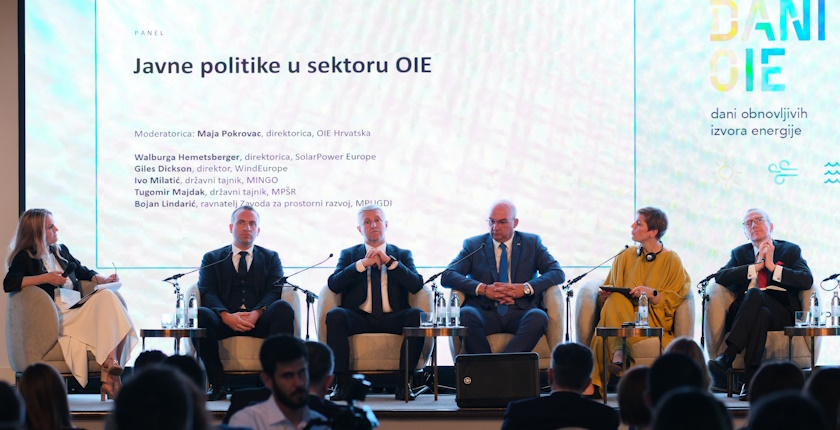
At the conference Days of Renewable Energy Sources, organized in Pula by Renewable Energy Sources of Croatia (RES Croatia), Ivo Milatić announced that the Croatian Energy Regulatory Agency (HERA) will adopt the grid connection fee by July at the latest. This, he added, could enable the implementation of EUR 1 billion worth of projects, which have been waiting for HERA’s decision for a long time.
He added that amendments to the Law on Spatial Planning will determine the exact routes of transmission lines, and that by 2030 it will be known “where the wires will go.” By 2030, Milatić expects renewable sources to account for 8 GW of the country’s 10.5 GW electricity production capacity.
Croatia’s updated NECP will set higher green energy targets
Croatia is working on revising its National Energy and Climate Plan (NECP), which the EU has deemed unambitious, so as to increase the green energy targets, according to him.
By 2030, Croatia plans to connect 2,000 MW of wind farms, 319 MW of geothermal power plants, and 4,000 MW of photovoltaic power plants, he said, adding that he is convinced these numbers will be even higher.

Photo: DOKU FILMS
The targets for biogas and biomass in the original version of the NECP will remain unchanged, it was said at the conference that gathered around 400 participants.
Maja Pokrovac, director of RES Croatia, stressed the importance of the industry’s transformation, noting that the green transition not only enables progress in the form of clean energy, but also creates jobs for highly educated young people and spurs regional development.